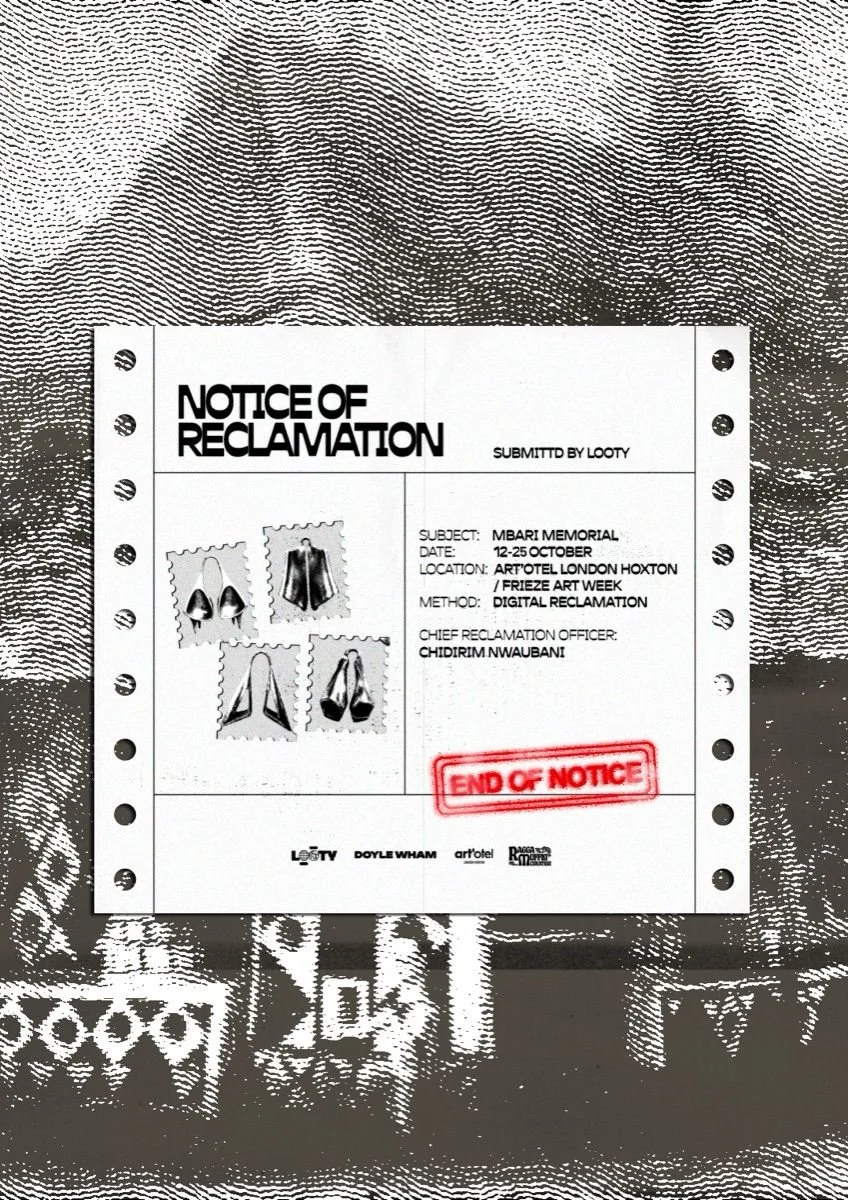
Mbari memorial

What Cannot Be Returned Must Be Reconceived

Cape Town Art Fair, 19th - 22nd February 2026

Mbari Memorial is a multidisciplinary installation which unfolds at the intersection of the physical, digital and spiritual realms. The installation’s participatory nature invokes the spirit of the Igbo art form of Mbari in southeastern Nigeria, in which communities gathered to collectively build sacred structures as offerings to Ala, the earth goddess. While this cultural practice was eradicated in the colonial era and its material traces largely languish in Western museums, Chidi Nwaubani does not propose an act of recovery or even remembrance, but a continuation of the culture through its essence: collaboration. This radical proposition upends the value systems upon which Western museums have been built, rejecting the separation of artefacts from society and the fixation on individual authorship. For Mbari Memorial to fulfil its revolutionary potential, it requires participants to adopt deep listening as a foundational practice, remaining attentive to the absences and echoes of the past, and open to collective possibilities. 

At the core of the installation is a series of new and interactive sculptures inspired by ogene: a type of gong traditionally used to summon communities to collaborate and construct the Mbari. The metal bodies of Nwaubani’s reimagined ogene harness their inherent conductivity, transforming the material of the sculpture itself into a sensor. This design poses a direct challenge to the gallery mandate of 'do not touch,' instead asking viewers to please touch, please interact, and please create. When two or more participants make contact simultaneously with the sculptures and each other, an electrical circuit is completed. This shared gesture activates the generation of a new digital sculpture. Each form is unique to that moment of contact, crystallising an act of communion which is rooted in the in-between, between the material and the immaterial, body and archive. The installation thus becomes what Mbari always was: not a collection of objects caged behind glass for passive admiration and economic valuation, but a communal, ritual, living imperative. 

By creating the conditions and technology that enable co-creation to take place, Nwaubani assumes the role of the master craftsmen who once instructed communities in the making of Mbari. As no Mbari structures survive today, his research necessarily draws on colonial photographic archives, which occupy an uneasy position as both evidence of cultural disruption and the only remaining sources of documentation. Mbari were never intended to be preserved. Once completed and offered to the goddess, the structures were left to decay, their purpose fulfilled. This deliberate impermanence challenges Western notions of cultural heritage that privilege objects and their preservation above all.  

This alternative African epistemology is further articulated through the design of Mbari Memorial. The ogene are presented on brightly coloured bottle crates, a display strategy Nwaubani first developed for the Venice Biennale di Architettura. Associated with systems of circulation and transport, the crates prompt a reconsideration of how cultural objects move and under what conditions they are encountered. This interrogation of the museum is central to the artist’s wider practice as the founder of LOOTY, which has gained international recognition for its use of LiDAR technology to digitally reclaim and release looted objects. In Mbari Memorial, Nwaubani broadens his critique of the museum by shifting attention from object to process, from the tangible to the intangible. Each shared activation of the ogene forms part of a growing, participatory archive, affirming to those who listen that the spirit of Mbari resides not in an object, photograph or museum, but in the collective.