The first solo exhibition of Chidirim Nwaubani & LOOTY.
Founded by Nwaubani in 2021, LOOTY uses innovative art and technology to reclaim stolen artworks, revive cultural heritage and transform narratives about cultural ownership.
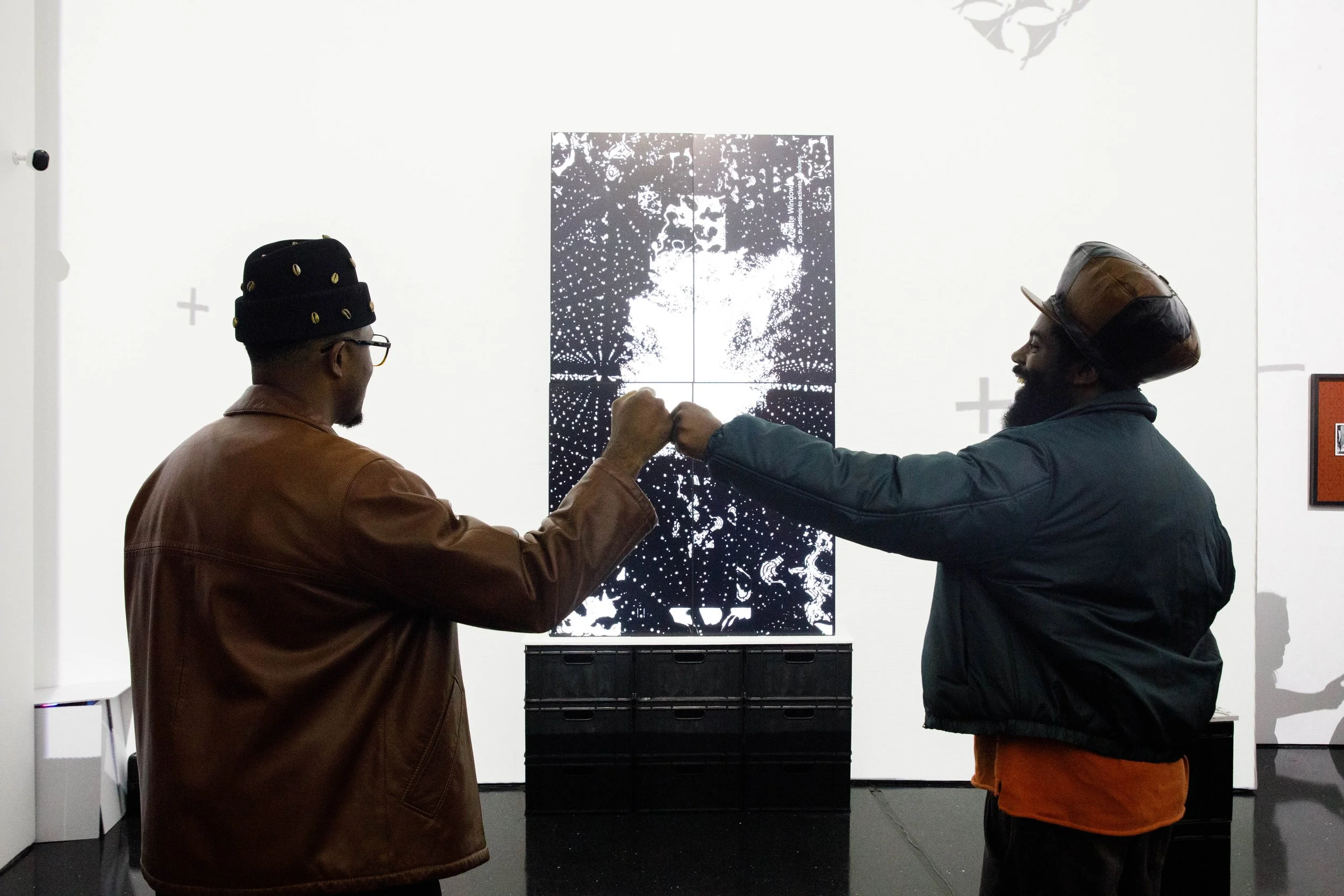
Nwaubani’s latest project, Mbari Memorial, is at the centre of the exhibition. The installation works through collective participation: touch the Ogene sculptures (named after the Nigerian metal gong) and make contact with each other to activate the generation of new digital sculptures. Through this process, Nwaubani is reactivating the spirit of Mbari, a Nigerian Igbo practice of collective creation that was wiped out as a consequence of colonial suppression and the Biafran war.
Until the late 1960s, in times of need, communities would come together to build Mbari houses: sacred and artistic spaces dedicated to the earth goddess Ala. The sound of the Ogene would summon people to create the Mbari. Today, the only physical traces of Mbari houses are ethnographic photographs and objects held in Western museums. However, the practice of Mbari is approached by Nwaubani not as a lost “artefact” to be recovered and preserved, but as a methodology of collective making to be continued.
Presented on bottle crates, associated with the visual culture of informal markets and economies, Nwaubani’s Ogene sculptures challenge the museum’s mandate of distance: touch is not prohibited but required, and meaning emerges not from contemplation but from participation. Exhibited alongside the sculptures is Nwaubani’s digital collage series If a Tree Falls..., which deconstructs the colonial photographic archive: cutting out the human figures to show how culture cannot be reduced to mere artefacts, while introducing recurring motifs inspired by the Ụlị patterns that marked the exterior of Mbari houses.
– Abridged text by Dr. Mariella Franzoni
Also featured in the exhibition are LOOTY’s groundbreaking digital heists. In 2023, Chidirim Nwaubani and Ahmed Abokor used archaeological LiDAR scanning technology to “steal back” the Rosetta Stone from the British Museum. In collaboration with Egyptologist Monica Hanna, they returned the stone to its place of origin, Rashid, using location-based AR technology. LOOTY has also digitally repatriated Benin Bronzes held at the British Museum, including the mask of Queen Idia. These are presented here as 3D-printed sculptures and as holograms.
WHAT CANNOT BE RETURNED MUST BE RECONCEIVED…
